This is included here because it gives insight into the different models. From the [http://www.porchboard.com/Instructions.html PorchBoard site]
The PorchBoard Bass plugs directly into an amplification system (set up much like a bass guitar would be.)using a quarter-quarter guitar cord or an XLR cord (or both simultaneously). No additional power sources or batteries are required.
Beginning tapping (heel on heel rail and toe on suspended toe rail) with a very simple beat, tapping once or twice each measure. With a little practice you will develop your own style and rhythm and your PorchBoard playing will become automatic.
Adjust the amplifier controls for tone and adequate volume. We suggest using a maximum setting on the low end (bass) control and then adjust the volume control so that a good sound is achieved with minimum tapping effort. Extreme tapping efforts are not necessary.
The UCL PorchBoard is designed to produce a tone in the 33-100 HZ range (very low). The 33 HZ (with a strong 99 HZ harmonic) was selected because it offers a strong supportive bass "thump" in any key- similar to a large marching band bass drum. Often the nature of the sound tends to resemble a note when another instrument (such as a guitar) suggests a note.
Excellent results can be obtained by using a quality bass amp, keyboard amp, capable PA system, powered subwoofer (the PorchBoard has adequate output to drive most powered subwoofers without the use of a pre-amp or any amplification system) that can reproduce these low frequencies at adequate levels.
The UCL-S PorchBoard has all the low-end benefits of the UCL model plus features a three way frequency response switch designed to match the frequency range of an increased number of amplifiers with higher frequency sound capability. The L (low) setting allows the very low bass, perfect for subwoofer or quality bass amp usage. The M (mix) setting filters a mix of low and high frequencies, and the H (high) setting provides for high end, stompbox slap.
The PorchBoard Floor Bass is a simple percussion instrument designed to be tapped by a foot to provide a "kick drum"-like sound. It could be classed as an instrument of indefinite pitch containing complex frequencies through which no discernible pitch can be heard.[1]
With very little audible sound by itself, the internal pickup provides both 1/4" and XLR output connections that may be used simultaneously.
See the PorchBoard website for more information about the available models.
Playing the PorchBoard through the L1®
Like any instrument, when you spend some time with it you can get different effects and be more expressive with it as you learn it's capabilities & limitations (and yours!).
You get a different sound based on where along the tap-rail you place your foot (as well as how hard, of course). This worked well for emphasizing different beats, with softer taps being near the outside end of the rail and the louder ones nearer the middle.
While sitting (which makes it *much* easier to use both feet!), I found it effective to place one foot over one end of the tap rail (over the support on one end) while the other foot did the tapping at various places. This acted something like a "damper" pedal/muffler, allowing me more control over how quietly I could 'tap'.
As with many percussive instruments, you definitely get different sounds when you do a
There's no reason to just tap with just the toe or ball of your foot. You can also turn it around to place the "tap-rail" (the one with the pickup under it) under your heel, so you tap by raising your heel rather than the toe. In a lot of ways that is often a more comfortable position for me when I'm playing the keyboard (raising the heel rather than the toe). Besides that, it uses different muscles -- so when my leg is getting a bit tired, I'll sometimes turn the PorchBoard around before the next song.
One can get really quiet taps by tapping on the "fixed" rail, rather than the "tap-rail"; that is, tap so the vibration goes through the whole board to the pickup, rather than tapping on the "tap-rail" itself (which is directly over the pickup). This effect, however, may vary widely, depending on which model of the PorchBoard you have.
The most interesting range of effects is possible when the gain is high enough that you have to tap softly most of the time. Besides that, it's a lot easier on the leg when you can minimize the effort involved in playing it. Yeah, it'll often "flash red" at those higher gains if you then stomp on the 'Board, but the associated distortion can (judiciously applied) have it's own place. Besides, why should guitarists be the only ones who have fun with deliberate distortion?!?! (Of course, for those of you who have seen Cliff Henricksen play the keyboard, if one stuck the PorchBoard under *his* foot you'd have to turn the gain waaaayyyy down! -- come to think of it, you'd really need two in order to stick one under each foot!)
Unlike an acoustic kick drum, or most other large drums, the PorchBoard seems to have few strong higher harmonics; for example, turning the High EQ way down seems to have little effect on the resulting sound.
The new (2007) UCL-S model offers all the low-end benefits of the UCL plus features a 3-way frequency response switch designed to match the frequency range of an increased number of amplifiers with higher frequency sound capability.
The L (low) setting allows the very low bass, perfect for subwoofer or quality bass amp usage.
The M (mix) setting filters a mix of low and high frequencies, and
The H (high) setting provides for high end, stompbox slap.
Also unlike an acoustic kick drum, the PorchBoard has very little intrinsic sense of "pitch" -- little sense of "playing a note". What that means is that when you play it by itself, it is rather bland and boring. The good aspect of that, however, is that it will complement most anything playing along with it -- you never have to "tune it up".
Because of producing predominately low-end sounds, it really demonstrates some of the "curses" of bass sound which Hilmar-at-Bose talks about -- such as how the volume of bass sounds can vary radically at different positions in the room. For example, at one point during an "acoustic jam", someone came up and turned down the volume a bit on the remote channel for the PorchBoard, whispering to the performer "it was way too loud in the back of the room" -- but from where the performer was sitting the sound seemed to be nicely "underneath" the other folks playing.
The best sound of the PorchBoard seems to come when played through an Extended Bass L1 System (one with 4 B1 Bass Module's); four B1 Bass Module's provide the broad dynamic low range which can bring out the variety of volumes one has with most percussive instruments. However, it can also sound just fine through single or double B1 Bass Module Systems, too. However, it is not recommend for use with an L1 without at least one B1 Bass Module attached.
The PorchBoard is uses a proximity sensor originally designed for the automotive industry rather than a musical instrument pickup. The sensor does not require a preamp and can be plugged into the line level inputs of the L1®. On the L1 Classic and L1 Model I that would be Channels 3 or 4. On the T1 ToneMatch Audio Engine you can use Channel 4/5.
Since it is (usually) sitting on the floor, you might need to be careful about what other pieces of electrical devices are near it. For example, a "wall-wart" (an external power supply or transformer) next to it might cause a 60-cycle 'hum' to be amplified. (This has happened, at least with the older "solid" model.)
Enroute Music invented, manufactures and distributes (both wholesale and retail) the PorchBoard Bass
Principals:
Nadene Isackson - Owner
Bill Stevens - Inventor
Dean Dwyer - Designer
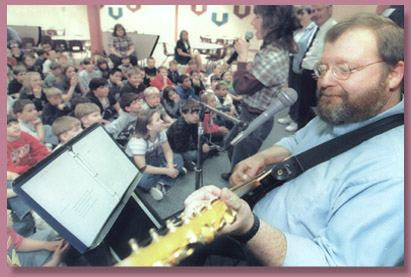
Enroute Music Choices A Drug Abuse Prevention Elementary School Assembly Program read this to get some insight into the people behind the PorchBoard.
Technology
Proximity Sensor
From the PorchBoard website:
Our patented passive proximity sensor system creates an analog, clean bass beat without the common low-end amplification problems of noise, feedback or delay.
Added notes from Bill
Microphones and piezo pickups make use of a resonant surface, leading to noise and feedback, especially when amplifying low-end. Regular guitar pickups are wide range and not tuned to a specific frequency
Background
Notes from Nadene Isackson
From his prior work in the automobile industry, Bill was familiar with electrically tuning a magnetic sensor for specific applications. This was the basis for our 'proximity sensor system', which uses a tuned, magnetic sensor that is capable of producing a very low dominate pitch when approached by a ferrous transducer plate.
By eliminating the common problems associated with the resonant surfaces used with microphone and piezo pickups and by eliminating the wide range frequencies that are used with guitar style pickups, the PorchBoard can consistently produce a specific, rich, low-end thump without noise or feedback.
The passive proximity sensor system is the basis of the PorchBoard patent that was granted to Bill and assigned to Nadene, owner of EnRoute Music.
The Instrument
General Description
constructed using durable composites
features XLR and 1/4" outputs
passive - no batteries or additional power sources are required.
no noise, feedback or delay
disassembles for compact travel (no tools required)
includes two interchangeable heel rails to accommodate seated or standing musicians
includes a handy carry bag
Assembled
Long Heel Rail - Seated
The PorchBoard using the Long Heel Rail for playing while seated.
Short Heel Rail - Standing
The Porchboard using the Short Heel Rail for playing while standing.
Disassembled
The PorchBoard ships with both Long and Short Heel Rails.
UCL-S
The UCL-S model is identical to the UCL (shown above) except that it has a 3-way frequency response switch for increased amplification capabilities
Instructions
This is included here because it gives insight into the different models. From the PorchBoard site
The PorchBoard Bass plugs directly into an amplification system (set up much like a bass guitar would be.)using a quarter-quarter guitar cord or an XLR cord (or both simultaneously). No additional power sources or batteries are required.
Beginning tapping (heel on heel rail and toe on suspended toe rail) with a very simple beat, tapping once or twice each measure. With a little practice you will develop your own style and rhythm and your PorchBoard playing will become automatic.
Adjust the amplifier controls for tone and adequate volume. We suggest using a maximum setting on the low end (bass) control and then adjust the volume control so that a good sound is achieved with minimum tapping effort. Extreme tapping efforts are not necessary.
The UCL PorchBoard is designed to produce a tone in the 33-100 HZ range (very low). The 33 HZ (with a strong 99 HZ harmonic) was selected because it offers a strong supportive bass "thump" in any key- similar to a large marching band bass drum. Often the nature of the sound tends to resemble a note when another instrument (such as a guitar) suggests a note.
Excellent results can be obtained by using a quality bass amp, keyboard amp, capable PA system, powered subwoofer (the PorchBoard has adequate output to drive most powered subwoofers without the use of a pre-amp or any amplification system) that can reproduce these low frequencies at adequate levels.
The UCL-S PorchBoard has all the low-end benefits of the UCL model plus features a three way frequency response switch designed to match the frequency range of an increased number of amplifiers with higher frequency sound capability. The L (low) setting allows the very low bass, perfect for subwoofer or quality bass amp usage. The M (mix) setting filters a mix of low and high frequencies, and the H (high) setting provides for high end, stompbox slap.