L1 Pro32 with Sub1 and L1 Pro16: Difference between revisions
Jump to navigation
Jump to search
mNo edit summary |
mNo edit summary |
||
| Line 10: | Line 10: | ||
;Answer: The result will be the same as running the Sub2 alone. The Sub2 plus Sub1 is only slightly louder than the Sub2 alone. | ;Answer: The result will be the same as running the Sub2 alone. The Sub2 plus Sub1 is only slightly louder than the Sub2 alone. | ||
;Testing, testing | |||
:I have an L1 Pro32 with Sub1, and I connected an L1 Pro 16 to the L1 Pro32 line out and then cranked up the volume on everything. I turned the Sub1 off/on and heard almost no difference. The L1 Pro16 drowned out the Sub1. I expect the result would be the same with a Sub1 and a Sub2; the Sub2 would drown out the Sub1. | :I have an L1 Pro32 with Sub1, and I connected an L1 Pro 16 to the L1 Pro32 line out and then cranked up the volume on everything. I turned the Sub1 off/on and heard almost no difference. The L1 Pro16 drowned out the Sub1. I expect the result would be the same with a Sub1 and a Sub2; the Sub2 would drown out the Sub1. | ||
:The math: If you run a Sub2 and add another Sub2, you can expect up to +6 dB SPL. You get +3 dB from doubling the power and up to +3 dB from acoustic coupling (if the units are stacked or side-by-side). However, if you run a Sub2 and add Sub 1, you '''might''' get up to +3 dB SPL, because you are adding less than half as much power and half as much surface area. | :The math: If you run a Sub2 and add another Sub2, you can expect up to +6 dB SPL. You get +3 dB from doubling the power and up to +3 dB from acoustic coupling (if the units are stacked or side-by-side). However, if you run a Sub2 and add Sub 1, you '''might''' get up to +3 dB SPL, because you are adding less than half as much power and half as much surface area. | ||
Revision as of 23:10, 18 April 2021
 This article expresses my opinion and experience. Please post comments to Twitter @ST_Muso or LinkedIn @STPro. Thank you — ST. |
- Question
- What benefit will there be adding a Sub2 to an L1 Pro32 with a Sub1
- Answer
- The result will be the same as running the Sub2 alone. The Sub2 plus Sub1 is only slightly louder than the Sub2 alone.
- Testing, testing
- I have an L1 Pro32 with Sub1, and I connected an L1 Pro 16 to the L1 Pro32 line out and then cranked up the volume on everything. I turned the Sub1 off/on and heard almost no difference. The L1 Pro16 drowned out the Sub1. I expect the result would be the same with a Sub1 and a Sub2; the Sub2 would drown out the Sub1.
- The math: If you run a Sub2 and add another Sub2, you can expect up to +6 dB SPL. You get +3 dB from doubling the power and up to +3 dB from acoustic coupling (if the units are stacked or side-by-side). However, if you run a Sub2 and add Sub 1, you might get up to +3 dB SPL, because you are adding less than half as much power and half as much surface area.
- Background
I have two L1 Pro32 with Sub1 systems. I chose the Sub1 option for portability.
I have two L1 Pro16 systems. I chose these because they have the J-shape projection pattern (good for playing on elevated stages) AND the output to the bass transducer is 1000 watts RMS (similar to the Sub2).
Note:
- Sub1 480 Watts RMS into the 7 x 13" racetrack transducer.
- L1 Pro16 1000 Watts RMS into the 10 x 18" transducer.
| Feature | Bose L1 Pro16 | Bose L1 Pro32 |
|---|---|---|
 |
 |
|
| Feature | Bose L1 Pro16 | Bose L1 Pro32 |
| Horizontal dispersion | 180 degrees | 180 degrees |
| Vertical dispersion | 0/-30 degrees (J-shape) | 0 degrees (straight shape) |
| Output | 118 dB / 124 dB peak | With Sub1: 117 dB / 123 dB peak
With Sub2: 122 dB / 128 dB peak |
| Speaker Array | Sixteen 2.00" (51 mm) articulated cricket drivers | Thirty two 2.00" (51 mm) articulated cricket drivers |
| Woofer | One 10"x 18" neodymium racetrack transducer in the power stand | Sub1:One 7" x 13" neodymium racetrack transducer
Sub2:One 10"x 18" neodymium racetrack transducer |
| Low Frequency | 42 Hz - 3dB | With Sub1: 40 Hz - 3dB With Sub2: 37 Hz - 3dB |
| Crossover | 200 Hz | 200 Hz |
| Power to speakers | Biamped
|
Biamped
|
| Weight | Total system weight 18 kg (54.9 lb)
|
Total system weight with
Sub1 29.1 kg (62.7 lb) Sub2 36.4 kg (79.3 lb)
|
| Dimensions (H x W x D) | 201.2 x 35.5 x 45.6 cm
(79.2 x 14.0 x 18.0 in) |
L1 Pro32
213.5 × 34.5 × 55 cm (84.1 × 13.6 × 21.7 in) Sub1 53.0 × 25.0 × 53.0 cm (20.9 × 9.8 × 20.9 in) Sub2 69.0 × 30.5 × 55.0 cm (27.2 × 12.0 × 21.7 in) Footprint (floor space required) L1 Pro32 with Sub1 (W x D) 59.4 x 55.1 cm (23.4 x 21.7 in) L1 Pro32 with Sub2 (W x D) 65.0 x 55.1 cm (25.6 x 21.7 in) |
| Power Stand Height (front | rear) | 66 front | 62.23 rear cm
26 front | 24.5 rear inches |
10.16 front | 10.16 rear cm
4 front | 4 rear inches |
| Sound Projection | 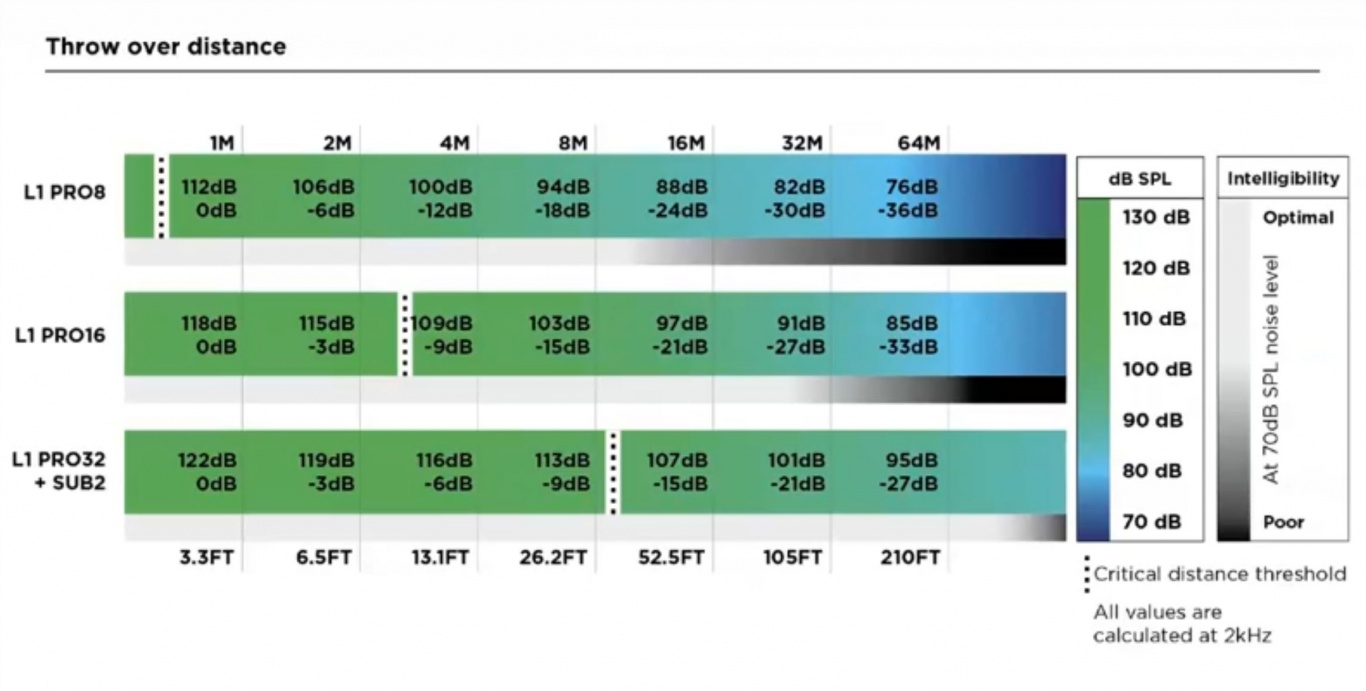
|
|
| Everything below this bar is the same for both | ||
| ToneMatch® Presets | Channels 1 and 2 Full suite of ToneMatch Presets available in the ToneMatch mixers, built-in. Set using the Bose App. |
Channels 1 and 2 Full suite of ToneMatch Presets available in the ToneMatch mixers, built-in. Set using the Bose App. |
| Battery | No | No |
| Connections | Channels 1 and 2
Combo Jacks XLR / 6 mm (1/4" Tip-Ring or Tip-Ring-Sleeve) balanced / unbalanced Channel 3/Aux Input
|
Channels 1 and 2
Combo Jacks XLR / 6 mm (1/4" Tip-Ring or Tip-Ring-Sleeve) balanced / unbalanced Channel 3/Aux Input
|
| Tone Controls | Channels 1 and 2 * Bass / Treble Channel 3 * None | Channel 1 * Bass / Treble Channel 2 * None |
| Line Out | XLR balanced | XLR balanced |
| Bluetooth input | Yes: Channel 3
Supports Bluetooth 5.x |
Yes: Channel 3
Supports Bluetooth 5.x |
| Reverb | Channels 1 and 2 Yes Channel 3 None |
Channels 1 and 2 Yes Channel 3 None |
| ToneMatch Port | Yes full support for T4S/T8S power only for T1 |
Yes full support for T4S/T8S power only for T1 |
| System EQ | Yes Live/Music/Speech/Off |
Yes Live/Music/Speech/Off |
| Scenes | Yes Store/recall system settings via Bose App |
Yes Store/recall system settings via Bose App |
| BBose App | Yes Wireless control over volume, tone, reverb and system EQ |
Yes Wireless control over volume, tone, reverb and system EQ |