PackLite® power amplifier Model A1: Difference between revisions
m Added Template to PackLite Extended Bass Package |
mNo edit summary |
||
| (21 intermediate revisions by the same user not shown) | |||
| Line 1: | Line 1: | ||
== The [http://www.bose.com/controller? | == The [http://www.bose.com/controller?url=/shop_online/speakers/portable_amplification_systems/accessories/l1_packlite_bass_pkg.jsp PackLite® power amplifier Model A1] == | ||
{| | {| | ||
|- | |- | ||
| __TOC__ | | __TOC__ | ||
| {{ | | {{PackLite® Extended Bass Package}} | ||
*[http://bose.infopop.cc/eve/forums/a/tpc/f/4806048934/m/1011016062/p/1 Kyle-at-Bose Introduces the A1 PackLite® power amplifier] | *[http://bose.infopop.cc/eve/forums/a/tpc/f/4806048934/m/1011016062/p/1 Kyle-at-Bose Introduces the A1 PackLite® power amplifier] | ||
*[[ | *[[L1® PackLite® A1 Amplifier / FAQ|Bose PackLite FAQs]] | ||
*<html> | *<html> | ||
<script type="text/javascript" src="/thickbox/jquery-compressed.js"></script> | <script type="text/javascript" src="/thickbox/jquery-compressed.js"></script> | ||
| Line 17: | Line 17: | ||
|} | |} | ||
<!-- | |||
http://bose.infopop.cc/eve/forums/a/ga/ul/9061073062/inlineimg/Y/whatAmI.jpg | http://bose.infopop.cc/eve/forums/a/ga/ul/9061073062/inlineimg/Y/whatAmI.jpg | ||
--> | |||
<br> | <br> | ||
=== | === Documentation === | ||
[[Media:Og eng packlite.pdf|A1 PackLite® Owners Guide]] | |||
[[Media:A1 PackLite Service Manual.pdf|A1 PackLite Service Manual]] | |||
[ | === Fan Operation === | ||
The fan turns on when the signal level is high, rather than using a thermal detector. When the | |||
input signal reaches about -10 dBV, the fan will turn on. <ref> [[Media:A1 PackLite Service Manual.pdf|A1 PackLite Service Manual]], page 49</ref> | |||
=== What does the Red LED mean === | === What does the Red LED mean === | ||
| Line 44: | Line 46: | ||
The {{A1}} Red light comes on about 1.5 dB below limiting.<ref>Bill-at-Bose {{Forum}} http://bose.infopop.cc/eve/forums/a/tpc/f/3976055944/m/6121039062?r=7061054093#7061054093</ref> | The {{A1}} Red light comes on about 1.5 dB below limiting.<ref>Bill-at-Bose {{Forum}} http://bose.infopop.cc/eve/forums/a/tpc/f/3976055944/m/6121039062?r=7061054093#7061054093</ref> | ||
{{:PS1 Powerstand/Bass Line Out}} | === Product Variants 120V 220V === | ||
The PackLiteTM A1 amplifier has been manufactured in two versions, a 120V version (product | |||
code 039057) and a 220-240V version (product code 039058)<ref>[[A1_PackLite_Service_Manual.pdf|A1 PackLite Service Manual]]</ref> | |||
Here is a photo of the 120V version. | |||
[[File:A1 PackLite 100-120V.jpg|400px|North American 100-120V version]] | |||
AC power connector: Accommodates the supplied AC power cord to connect your amplifier to the appropriate AC (mains) outlet. Check the product label of your amplifier for the voltage rating: 120V or 230V. | |||
[[File:A1 PackLite Power.jpg|400px|A1 PackLite Owners Guide]] | |||
=== Application Notes === | |||
==== {{Model II}} with {{B2}} ==== | |||
[[Image:A1 Model II.png]] | |||
Note: The Model II Power Stand processes the bass signal differently with a B2 compared to a B1. The LED on the A1 will hit red sooner. If you don't hear any clipping, then you're okay. However, if you hear clipping from the B2 connected to the A1, then you can use a 10 dB [[Pad|Pad]] to attenuate the signal from the Model II Power Stand to the A1. That's connection 2 (green line) in the diagram above. Note: Most inline attenuation pads use XLR connectors so you may need to get some Tip-Ring-Sleeve to XLR adapters to make the connections. | |||
For notes on how the {{A1}} works with the rest of the {{PAS}} see [[PS1 Powerstand Bass]]. | |||
{{:PS1 Powerstand/Bass Line Out}} | |||
== General Questions and Answers == | |||
[http://bose.infopop.cc/eve/forums/a/tpc/f/3976055944/m/6121039062?r=2531054162#2531054162 originally posted by Kyle-at-Bose in response to questions from Oldghm] October 20, 2005 | |||
Note - all references to the system or the L1® are to the {{Classic}}. | |||
In keeping with the premise that musicians should worry less about the gear, the system was designed to be smart about bass management. We did not want you the musician to be tasked with having to re-EQ the system depending on how much bass you decided to use. So, whether you go from zero B1s to 1 B1, to 2 B1, to 4 B1s, the system is making changes to the crossover and level to compensate the fact that you have added (or taken away) bass modules. | |||
We did this so that the system maintains a spectral balance as best as possible so that you didn't have to manage the difference yourself. Of course with zero B1s we are not able to maintain a the wide band down to 40 Hz. The L1 does it's best down to 110 Hz. By adding B1s however the system simply shifts the crossover to 180 Hz, applies active EQ to the B1s and will attenuate the output depending on how many B1s you decide to use. As you add amplification and loudspeakers we gain more overall output in the bass frequencies. To maintain that spectral balance, we simple reduce the signal going out to the B1s (or PackLite amplifier) so that you don't need to fuss with the remote tone controls or have special presets for how many B1s (yikes!). The same tone that you found with presets and tone control adjustments with lower levels (less B1s) is now available at higher levels in those regions (more B1s). | |||
This however is not to say that the L1 will get louder. Bass-heavy instruments like bass guitar and kick drum had a good tone at lower levels with, let's say, a single B1. Unfortunately, these players have probably found that if they needed more punch in larger rooms that a single B1 only went so far and that the L1 continued to get louder. Two B1s give you the ability to substantially get louder in the bass region- more headroom with two B1s. In expansion, 4 B1s give bass players even more headroom to play. (I believe 4 B1s will satisfy most bass players in a variety of larger venues, we've tried 8 B1s and it just seems way too much) | |||
Said another way: As soon as you plug in a PackLite and two B1s, you will not feel a difference in sound. It was designed to perform like this! What you will find is that you NOW have the ability to change your tone. Go ahead, grab the remote tone knobs, change the preset if you want- you now can tailor your bass-heavy instruments in a way that was not so audible before with less B1s. | |||
Originally posted by Oldghm: | |||
:I have never claimed to have a full and complete understanding of the bass thing, so I've been doing some reading from a while back and ran across something from Hilmar that might help me understand how and why you can go from 1 B1 to 4 B1's and not hear a major difference from a vocal or acoustic guitar that really just goes down to 80hz or so. | :I have never claimed to have a full and complete understanding of the bass thing, so I've been doing some reading from a while back and ran across something from Hilmar that might help me understand how and why you can go from 1 B1 to 4 B1's and not hear a major difference from a vocal or acoustic guitar that really just goes down to 80hz or so. | ||
Yes, that's correct. Fundamental frequencies of those instruments are not present below 80Hz. That is why you'll find 80Hz high-pass switches on so many mixers and microphones- it allows you to trash those unwanted frequencies. In a performance | Yes, that's correct. Fundamental frequencies of those instruments are not present below 80Hz. That is why you'll find 80Hz high-pass switches on so many mixers and microphones- it allows you to trash those unwanted frequencies. In a performance environment it halts the pickup of unwanted bass frequencies (instruments, HVAC units, crowd rumble) from bleeding into your mics. | ||
Oldghm: | |||
:Hilmar mentioned the crossover being "smart". It changes as more B1's are added. | |||
That's right. The crossover critical frequency remains the same with one or more B1s added (or use of the Bass-Line OUT connector)- 180 Hz. The other end of the intellegence comes from knowing if you have 0, 1, 2, or 4 B1s connected and attenuating the signal where appropriate to compensate. | |||
Oldghm: | |||
:Please correct me if I'm wrong, but, can we assume that the crossover drops, lower and lower, as B1's are added? Thus as you add B1's less and less of the acoustic guitar bottom end is actually going to the B1's. | :Please correct me if I'm wrong, but, can we assume that the crossover drops, lower and lower, as B1's are added? Thus as you add B1's less and less of the acoustic guitar bottom end is actually going to the B1's. | ||
<br> No, all bottom end (below 180Hz) is being routed to B1s always. The level out to bass modules will drop but only to balance the fact that more acoustic output is being gained by adding bass modules. By increasing the MASTER you'll see that all of that power is available to you, just in a balanced fashion. | |||
Oldhm: | |||
:Is it possible that with 4 or more B1's we actually go backwards to the point that nearly all of the acoustic guitar is in the L1? Almost as if we didn't have a B1 attached. | :Is it possible that with 4 or more B1's we actually go backwards to the point that nearly all of the acoustic guitar is in the L1? Almost as if we didn't have a B1 attached. | ||
Never. Never! | Never. Never! | ||
Oldghm: | Oldghm: | ||
:What is the crossover when using the PS1 / L1 with 2B1's and the PackLite with 2 B1's, for a total of 4 B1's? | |||
The crossover point is 180Hz ({{Classic}}) | |||
Oldghm: | |||
:Is there any way to trick the "smart" crossover, and still get good results from the B1's? | |||
:Is the | |||
There is no way to change the crossover frequency point of the system. | |||
Oldghm: | |||
:Is the L1 less, just as, or more, efficient at dispersing those frequencies between 110 hz and 180 hz? | |||
Hilmar can speak to dispersion patterns better than I can but it's my understanding that 110-180 Hz doesn't do a great job at being a cylindrical wavefront anyway. Considering that it's also in a range that's not perceptibly directional (bass), it was decided to route that down to the B1 that does a much better job reproducing those frequencies. As a listener, we have a hard time hearing where that range is coming from so to the B1 on the floor it goes. | |||
Steve-at-Bose joined in... | |||
Oldghm | Oldghm: | ||
:Please correct me if I'm wrong, but, can we assume that the crossover drops, lower and lower, as B1's are added? Thus as you add B1's less and less of the acoustic guitar bottom end is actually going to the B1's. | |||
<br> I think the key thing to communicate here is that adding a PackLite(tm) amp and more B1s adds more output when you need it. | |||
Oldghm, the crossover does not change frequency location. It remains at 180 Hz. What I believe Hilmar was talking about is that the system has more low frequency output capability as you add B1s so the EQ adjusts accordingly. | |||
It | This is a great topic of conversation and it is clearly something we've got to figure out with PackLite marketing materials. It's a complicated thing to communicate. | ||
Here's my attempt to simplify what's going on. | |||
Adding the PackLite(tm) Extended Bass Package (4 B1s total) gives you the ability to have more acoustic output from 180Hz down. | |||
It does not change the spectral balance (acoustic output from 180Hz down) of the system until you reach a volume level that exceeds the capability of 2 B1s. | |||
By the way, you can get more bass by turning the "Bass" knob on the R1 remote and change the spectral balance that you're asking the system to reproduce. | |||
Clear as mud? | |||
The challenge we have is that we, as musicians and speaker buyers, have been trained to think of buying things in bits. Need more bass, buy more bass speakers and you'll have it. That's because the stuff we buy is not designed to work together. | |||
When an engineer gets to design and optimize the entire solution, they can really do some great things. One of which is make the most out of the output of an amp and a speaker cone working together. That's what the gang here did with the Power Stand and the B1 bass module. They work really well together. | |||
Eventually, as you raise the volume, the acoustic output of the amp and speaker cone reaches its limit and the system says "all done", that's as much bass as I can throw. That's when adding more B1s and a PackLite amp will help ... when you've reached the limit. | |||
It's a pretty hard thing to communicate. We know that a customer is going to be running 2 B1s, hook up a PackLite amp and 2 more B1s and say "hey, there's no noticeable change." and we'll say "yeah, isn't that cool?" to which a customer will say "huh??". Then we say, "well you've added headroom without changing the spectral balance of the system without touching a crossover knob, or an EQ ... just try that with any other speaker system out there" with a big, full of pride, grin on our face. | |||
The customer might then say, "so why buy it?" to which we'll say, "now turn up and down and notice how great the system sounds at any volume without you having to touch any knobs ... it's like bringing Hilmar to your gig to run the volume and EQ controls for your band ... COOL huh?" | |||
Hopefully, with your help we'll find the short way (or analogy) to describing this very cool benefit. Believe me, the engineering team worked hard to give you this benefit. It's real. It would have been WAY easier to develop a solution that was "slap an A1 & 2 more B1s on and boom, more bass; now everything sound good at one volume and muddy at another." | |||
<br> For more see [http://bose.infopop.cc/eve/forums/a/tpc/f/3976055944/m/6121039062?r=2531054162#2531054162 the original discussion] | |||
== {{A1}} on top of Bass Modules == | |||
[[Image:PackLite on top of Bass Modules.png]] | |||
== Compatibility with Other Members of the L1® Family of Products == | |||
{{L1 Compatibility}} | |||
---- | |||
<references /> | |||
[[Category:A1_PackLite®]] [[Category:Bass]] [[Category:LED]] [[Category:L1™_System]] [[Category:PS1_Powerstand]] | |||
Latest revision as of 04:17, 16 September 2024

|
Documentation
Fan Operation
The fan turns on when the signal level is high, rather than using a thermal detector. When the input signal reaches about -10 dBV, the fan will turn on. [1]
What does the Red LED mean
From page 7 in the A1 PackLite® Owners Guide

From page 11 in the A1 PackLite® Owners Guide

And
The PackLite® power amplifier model A1 Red light comes on about 1.5 dB below limiting.[2]
Product Variants 120V 220V
The PackLiteTM A1 amplifier has been manufactured in two versions, a 120V version (product code 039057) and a 220-240V version (product code 039058)[3]
Here is a photo of the 120V version.

AC power connector: Accommodates the supplied AC power cord to connect your amplifier to the appropriate AC (mains) outlet. Check the product label of your amplifier for the voltage rating: 120V or 230V.

Application Notes

Note: The Model II Power Stand processes the bass signal differently with a B2 compared to a B1. The LED on the A1 will hit red sooner. If you don't hear any clipping, then you're okay. However, if you hear clipping from the B2 connected to the A1, then you can use a 10 dB Pad to attenuate the signal from the Model II Power Stand to the A1. That's connection 2 (green line) in the diagram above. Note: Most inline attenuation pads use XLR connectors so you may need to get some Tip-Ring-Sleeve to XLR adapters to make the connections.
For notes on how the PackLite® power amplifier model A1 works with the rest of the Bose® Personalized Amplification System™ family of products see PS1 Powerstand Bass.
Bass Line Out and B1 behavior

The behavior of the bass line out and B1 Bass Module outputs on the L1 Classic / L1 Model I / L1 Model II are based on the philosophy that adding B1 Bass Modules should give the user more dynamic range (can play louder) but should not alter the tone of the instrument, including tone adjustments made using the R1 Remote, the T1 ToneMatch Audio Engine or other tone-shaping equipment.
This philosophy is notably different from other manufacturers, who take the approach that it's okay (or desirable) that adding more bass speakers causes the instrument tone to become "bassier".
With this philosophy in mind, here is how the bass line out and B1 outputs work.
No cable plugged into the Bass Line out
| B1s connected | Output | EQ | Bass Signal Gain | Notes |
|---|---|---|---|---|
| 1 | 40Hz-180Hz | B1 specific EQ | Reference Level | |
| 2 | 40Hz-180Hz | B1 specific EQ | Reference Level -6 dB | Why? Because when you add a second B1, if you did not change the signal strength you would get 6 dB more bass relative to the mids and highs. This would alter the tone of the instrument. To keep the tone the same, while still allowing the more dynamic range (system can play louder by 6 dB) the signal level must be reduced by 6 dB. |
Cable connected to the Bass Line Out
| B1s connected | Output | EQ | Bass Signal Gain | Notes |
|---|---|---|---|---|
| 0 | 40Hz-180Hz | Flat EQ | Reference Level -6 dB | |
| 1 | 40Hz-180Hz | B1 specific EQ on Bass Line Out and B1 Out | Reference Level - 6 dB | If you are using a PackLite® power amplifier model A1 Extended Bass Package this is a total of 3 B1s (2 on the A1 and 1 on the Power Stand) |
| 2 | 40Hz-180Hz | B1 specific EQ on Bass Line Out and B1 Out | Reference Level -12 dB | If you are using a PackLite® power amplifier model A1 Extended Bass Package this is a total of 4 B1s (2 on the A1 and 2 on the Power Stand) |
With More Than 4 B1s
The Power Stand does not measure the exact number of PackLite® power amplifier model A1s, so there is a slight error if you use anything but 1,2, or 4 B1s.
For 6 B1s you will be 3.5 dB bass heavy, for 8 B1s it'll be 6 dB heavy.
B2 EQ
Bass Line Out: Model II post firmware 1.4 with System EQ 1.04


September 2012
- Bose released Model II Power Stand Model II firmware 1.4 with System EQ 1.04 to support the B2 Bass Module with the three position Bass Level Switch ( + Normal - ). Note: Support and behaviors for B1(s) is unchanged.
- The behavior of the bass line out with the B2 Bass Module Bass Module outputs on the Model 1S and Model II are based on the philosophy that adding B2 Bass Modules should give the user more bass output immediately. This changes the tonal balance as soon as you add a second B2 using an PackLite® power amplifier model A1 connected to the Bass Line Out. This is unlike the behaviour with B1 bass modules where the signal is attenuated as you add more B1s to maintain the tonal balance at lower volume levels.
- Note: If no bass modules are detected at the Bass Module Output the Bass Line Out EQ will be set to the B2 curve with the B2 switch set to Normal.
- — Source Craig-at-Bose
No cable plugged into the Bass Line out
| B2 Bass Modules connected | Output | EQ | Bass Signal Gain | Notes |
|---|---|---|---|---|
| 1 | 40Hz-200Hz | B2 specific EQ as set by the B2 Bass Level Switch ( + Normal - ) is present at the Bass Module Out and the Bass Line Out | Reference Level | There are three B2 EQ settings possible using the B2 Bass Level Switch ( + Normal - ) |
Cable connected to the Bass Line Out
| B2 Bass Modules connected | Output | EQ | Bass Signal Gain | Notes |
|---|---|---|---|---|
| 0 | 40Hz-200Hz | B2 EQ as though B2 attached and B2 Bass Level Switch set to Normal position | Reference Level | This presents the B2 EQ with the B2 Bass Level Switch set to the Normal position. (No resistance detected between the 2+ and 2- pins of an NL4 plug) |
| 1 | 40Hz-200Hz | B2 specific EQ as set by the B2 Bass Level Switch ( + Normal - ) is present at the Bass Module Out and the Bass Line Out |
Reference Level | If you are using a PackLite® power amplifier model A1 Extended Bass Package this is a total of two B2s (one on the A1 and one on the Power Stand) |
Powered Subwoofers
The Model II is an integrated system that supports Bose B1 and B2 bass modules. Connecting powered subwoofers to the Model II Power Stand Bass Line Out is not supported because EQ curves for the B1 or B2 are present at the Bass Line Out. This may or may not result in good results with a powered subwoofer.
If you want to use a powered subwoofer, connect your signal source to the subwoofer and connect the subwoofer high pass filter output to the L1® (any model).
Output if no B1 Bass Modules detected at the Bass Module Output (powered output) the signal at the Bass Line Out is:
- 40-180 Hz with B2 EQ applied if you have the current L1® Model II Power Stand Firmware Updates
- If you do not have the current firmware the signal at the Bass Line Out is: 40-180 Hz Bandpass (that is: NO B1 EQ) [4]
- The system Crossover for the Cylindrical Radiator®s is 180 Hz
If one or two B1 Bass Modules is detected or emulated using resistors across NL4 2+ / 2- pins
- 40-180 Hz with different EQ curves
- The system Crossover for the Cylindrical Radiator®s is 180 Hz
For details on how to do this see: Activating B1 EQ Curves and Using a Different Sub
- Note — Operation of the B2 with the Model I/Classic is only supported with the B2 Bass Level Switch set to Normal.
- See: Is the B2 Bass Module Compatible with the L1® Classic or Model I
Bass Module Output (powered output)
For the sake of those attaching third party passive speakers (an unsupported application), the output characteristics are the same as for the the B2 Bass Module (section immediately above).
- ↑ A1 PackLite Service Manual, page 49
- ↑ Bill-at-Bose Bose® Pro Portable PA Community http://bose.infopop.cc/eve/forums/a/tpc/f/3976055944/m/6121039062?r=7061054093#7061054093
- ↑ A1 PackLite Service Manual
- ↑ Hilmar-at-Bose intelligent crossover
A) When there are no bass sources attached, lower the crossover and try to get as much bass out of the L1 as is reasonably feasible (110 Hz) in this case
B) If there are bass sources bring the crossover up to 180 Hz (where the L1 starts to get really efficient) AND adjust the bass gain so that the overall spectral balance is maintained no matter how many bass sources are attached.
Original Source - Hilmar-at-Bose
Use the proper cables
Warning - Use Blue B1 Cables NL4 cables with your L1 Classic / L1 Model I / L1 Model 1S L1 Model II


If you are using a B1 Bass Module with your Power Stand it is ESSENTIAL for proper operation that you use the BLUE cable supplied with the B1 Bass Module or B2 Bass Module. This is required so that the L1 Classic/L1 Model I/L1 Model 1S/L1 Model II Power Stand can correctly identify when there are bass modules connected to it and if so, how many.
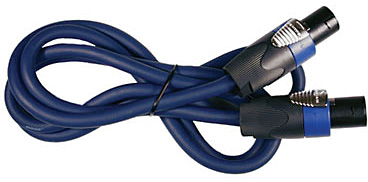
Please click the picture above for ordering information.
- Note
- The B2 Bass Level Switch will not change the sound of the B2 Bass Module if you are not using the correct cable.
See: PS1 Power Stand / Bass Line Out for details about how the Power Stand adapts to the number of bass modules are connected to it.
You may also use high quality NL4 cables (four conductor cables).
Alternate and longer cables for B1s
General Questions and Answers
originally posted by Kyle-at-Bose in response to questions from Oldghm October 20, 2005
Note - all references to the system or the L1® are to the L1 Classic.
In keeping with the premise that musicians should worry less about the gear, the system was designed to be smart about bass management. We did not want you the musician to be tasked with having to re-EQ the system depending on how much bass you decided to use. So, whether you go from zero B1s to 1 B1, to 2 B1, to 4 B1s, the system is making changes to the crossover and level to compensate the fact that you have added (or taken away) bass modules.
We did this so that the system maintains a spectral balance as best as possible so that you didn't have to manage the difference yourself. Of course with zero B1s we are not able to maintain a the wide band down to 40 Hz. The L1 does it's best down to 110 Hz. By adding B1s however the system simply shifts the crossover to 180 Hz, applies active EQ to the B1s and will attenuate the output depending on how many B1s you decide to use. As you add amplification and loudspeakers we gain more overall output in the bass frequencies. To maintain that spectral balance, we simple reduce the signal going out to the B1s (or PackLite amplifier) so that you don't need to fuss with the remote tone controls or have special presets for how many B1s (yikes!). The same tone that you found with presets and tone control adjustments with lower levels (less B1s) is now available at higher levels in those regions (more B1s).
This however is not to say that the L1 will get louder. Bass-heavy instruments like bass guitar and kick drum had a good tone at lower levels with, let's say, a single B1. Unfortunately, these players have probably found that if they needed more punch in larger rooms that a single B1 only went so far and that the L1 continued to get louder. Two B1s give you the ability to substantially get louder in the bass region- more headroom with two B1s. In expansion, 4 B1s give bass players even more headroom to play. (I believe 4 B1s will satisfy most bass players in a variety of larger venues, we've tried 8 B1s and it just seems way too much)
Said another way: As soon as you plug in a PackLite and two B1s, you will not feel a difference in sound. It was designed to perform like this! What you will find is that you NOW have the ability to change your tone. Go ahead, grab the remote tone knobs, change the preset if you want- you now can tailor your bass-heavy instruments in a way that was not so audible before with less B1s.
Originally posted by Oldghm:
- I have never claimed to have a full and complete understanding of the bass thing, so I've been doing some reading from a while back and ran across something from Hilmar that might help me understand how and why you can go from 1 B1 to 4 B1's and not hear a major difference from a vocal or acoustic guitar that really just goes down to 80hz or so.
Yes, that's correct. Fundamental frequencies of those instruments are not present below 80Hz. That is why you'll find 80Hz high-pass switches on so many mixers and microphones- it allows you to trash those unwanted frequencies. In a performance environment it halts the pickup of unwanted bass frequencies (instruments, HVAC units, crowd rumble) from bleeding into your mics.
Oldghm:
- Hilmar mentioned the crossover being "smart". It changes as more B1's are added.
That's right. The crossover critical frequency remains the same with one or more B1s added (or use of the Bass-Line OUT connector)- 180 Hz. The other end of the intellegence comes from knowing if you have 0, 1, 2, or 4 B1s connected and attenuating the signal where appropriate to compensate.
Oldghm:
- Please correct me if I'm wrong, but, can we assume that the crossover drops, lower and lower, as B1's are added? Thus as you add B1's less and less of the acoustic guitar bottom end is actually going to the B1's.
No, all bottom end (below 180Hz) is being routed to B1s always. The level out to bass modules will drop but only to balance the fact that more acoustic output is being gained by adding bass modules. By increasing the MASTER you'll see that all of that power is available to you, just in a balanced fashion.
Oldhm:
- Is it possible that with 4 or more B1's we actually go backwards to the point that nearly all of the acoustic guitar is in the L1? Almost as if we didn't have a B1 attached.
Never. Never!
Oldghm:
- What is the crossover when using the PS1 / L1 with 2B1's and the PackLite with 2 B1's, for a total of 4 B1's?
The crossover point is 180Hz (L1 Classic)
Oldghm:
- Is there any way to trick the "smart" crossover, and still get good results from the B1's?
There is no way to change the crossover frequency point of the system.
Oldghm:
- Is the L1 less, just as, or more, efficient at dispersing those frequencies between 110 hz and 180 hz?
Hilmar can speak to dispersion patterns better than I can but it's my understanding that 110-180 Hz doesn't do a great job at being a cylindrical wavefront anyway. Considering that it's also in a range that's not perceptibly directional (bass), it was decided to route that down to the B1 that does a much better job reproducing those frequencies. As a listener, we have a hard time hearing where that range is coming from so to the B1 on the floor it goes.
Steve-at-Bose joined in...
Oldghm:
- Please correct me if I'm wrong, but, can we assume that the crossover drops, lower and lower, as B1's are added? Thus as you add B1's less and less of the acoustic guitar bottom end is actually going to the B1's.
I think the key thing to communicate here is that adding a PackLite(tm) amp and more B1s adds more output when you need it.
Oldghm, the crossover does not change frequency location. It remains at 180 Hz. What I believe Hilmar was talking about is that the system has more low frequency output capability as you add B1s so the EQ adjusts accordingly.
This is a great topic of conversation and it is clearly something we've got to figure out with PackLite marketing materials. It's a complicated thing to communicate.
Here's my attempt to simplify what's going on.
Adding the PackLite(tm) Extended Bass Package (4 B1s total) gives you the ability to have more acoustic output from 180Hz down.
It does not change the spectral balance (acoustic output from 180Hz down) of the system until you reach a volume level that exceeds the capability of 2 B1s.
By the way, you can get more bass by turning the "Bass" knob on the R1 remote and change the spectral balance that you're asking the system to reproduce.
Clear as mud?
The challenge we have is that we, as musicians and speaker buyers, have been trained to think of buying things in bits. Need more bass, buy more bass speakers and you'll have it. That's because the stuff we buy is not designed to work together.
When an engineer gets to design and optimize the entire solution, they can really do some great things. One of which is make the most out of the output of an amp and a speaker cone working together. That's what the gang here did with the Power Stand and the B1 bass module. They work really well together.
Eventually, as you raise the volume, the acoustic output of the amp and speaker cone reaches its limit and the system says "all done", that's as much bass as I can throw. That's when adding more B1s and a PackLite amp will help ... when you've reached the limit.
It's a pretty hard thing to communicate. We know that a customer is going to be running 2 B1s, hook up a PackLite amp and 2 more B1s and say "hey, there's no noticeable change." and we'll say "yeah, isn't that cool?" to which a customer will say "huh??". Then we say, "well you've added headroom without changing the spectral balance of the system without touching a crossover knob, or an EQ ... just try that with any other speaker system out there" with a big, full of pride, grin on our face.
The customer might then say, "so why buy it?" to which we'll say, "now turn up and down and notice how great the system sounds at any volume without you having to touch any knobs ... it's like bringing Hilmar to your gig to run the volume and EQ controls for your band ... COOL huh?"
Hopefully, with your help we'll find the short way (or analogy) to describing this very cool benefit. Believe me, the engineering team worked hard to give you this benefit. It's real. It would have been WAY easier to develop a solution that was "slap an A1 & 2 more B1s on and boom, more bass; now everything sound good at one volume and muddy at another."
For more see the original discussion
PackLite® power amplifier model A1 on top of Bass Modules

Compatibility with Other Members of the L1® Family of Products
Cylindrical Radiator®s
Cylindrical Radiator®s are not interchangeable across models
Specifically (and without exception)
- The Cylindrical Radiator speaker sections of the L1 Classic, the L1 Model I and L1 Model 1S and the L1 Model II are not compatible with each other.
- The Cylindrical Radiator speaker sections of the L1 Classic can only be used with the Classic PS1 power stand (no orange markings on the input/output panel).
- The Cylindrical Radiator speaker sections of the L1 Model I (orange markings on the back of both sections) can only be used with the Model I PS1 power stand (orange markings on the input/output panel).
- The Cylindrical Radiator speaker sections of the L1 Model II can only be used with the L1 Model II power stand.
- The Cylindrical Radiator speaker sections of the L1 Model 1S can only be used with the L1 Model 1S power stand.
T1 ToneMatch® Audio Engine, T4S/T8S ToneMatch® Mixers


- The ToneMatch mixers can be used with the
PackLite® power amplifier Model A1

- The PackLite® power amplifier model A1 can be used with
B1 Bass Module
- The B1 Bass Module can be used with the
B2 Bass Module
- The B2 Bass Module can be used with the
- L1 Classic Normal Mode only
- L1 Model I Normal Mode only
- L1 Model 1S all modes
- L1 Model II all modes but L1® Model II Power Stand Firmware version 1.4 or later required