L1 Loudness Behind: Difference between revisions
mNo edit summary |
mNo edit summary |
||
| (4 intermediate revisions by the same user not shown) | |||
| Line 5: | Line 5: | ||
|RightBody = The L1 systems offer extremely wide horizontal coverage (approximately 180 degrees), however, we rarely consider loudness behind them. | |RightBody = The L1 systems offer extremely wide horizontal coverage (approximately 180 degrees), however, we rarely consider loudness behind them. | ||
If you find the | If you find the L1 systems too loud when placed behind you, consider using high-quality hearing protection. Putting them beside or ahead of you will make very little difference for frequencies up to 1000 Hz or the sensation of loudness. | ||
If you place the L1 beside you, the sound is very little different from directly in front. This is great for monitoring if you are on a shallow stage. | |||
Behind the L1 system, the sound will sound muffled because the mid-high frequencies are more directional than the lows. In testing (below) the difference was about 3 dB SPL (Sound Pressure Level). | |||
;Notes | |||
:This 3 dB difference was measurable in a free field (no walls). When there are walls, the difference is less apparent due to room reflections. | |||
:A change of 3 dB is accepted as the smallest difference in level that is easily heard by most listeners listening to speech or music. It is a slight increase or decrease in volume<ref> [https://www.e2s.com/references-and-guidelines/db-decibel-ratings db Decibel Ratings]</ref>. | |||
| Line 32: | Line 39: | ||
== Test Results == | == Test Results == | ||
The average difference measuring in front of an L1 and directly behind it (180 degrees off-axis) is +3 dB SPL dBA and dBC. | The average difference measuring in front of an L1 and directly behind it (180 degrees off-axis) is +3 dB SPL dBA and dBC. | ||
The average difference measuring in front of an L1 and beside it (90 degrees off-axis) is +3 dB SPL dBA and dBC. | The noticeable difference is that the sound behind the L1 is muffled (mid-high frequencies less apparent). | ||
<!--The average difference measuring in front of an L1 and beside it (90 degrees off-axis) is +3 dB SPL dBA and dBC. --> | |||
| Line 42: | Line 51: | ||
*A-weighted and C-weighted (dBA and dBC) | *A-weighted and C-weighted (dBA and dBC) | ||
;Notes | |||
:This 3 dB difference was measurable in a free field (no walls). When there are walls, the difference is less apparent due to room reflections. | |||
:A change of 3 dB is accepted as the smallest difference in level that is easily heard by most listeners listening to speech or music. It is a slight increase or decrease in volume<ref> [https://www.e2s.com/references-and-guidelines/db-decibel-ratings db Decibel Ratings]</ref>. | |||
==Further reading== | ==Further reading== | ||
Latest revision as of 18:14, 20 August 2024
How Loud is it if you put the L1s in front of you
The L1 systems offer extremely wide horizontal coverage (approximately 180 degrees), however, we rarely consider loudness behind them.
If you find the L1 systems too loud when placed behind you, consider using high-quality hearing protection. Putting them beside or ahead of you will make very little difference for frequencies up to 1000 Hz or the sensation of loudness.
If you place the L1 beside you, the sound is very little different from directly in front. This is great for monitoring if you are on a shallow stage.
Behind the L1 system, the sound will sound muffled because the mid-high frequencies are more directional than the lows. In testing (below) the difference was about 3 dB SPL (Sound Pressure Level).
- Notes
- This 3 dB difference was measurable in a free field (no walls). When there are walls, the difference is less apparent due to room reflections.
- A change of 3 dB is accepted as the smallest difference in level that is easily heard by most listeners listening to speech or music. It is a slight increase or decrease in volume[1].
Major Concepts
How Directional are the L1s
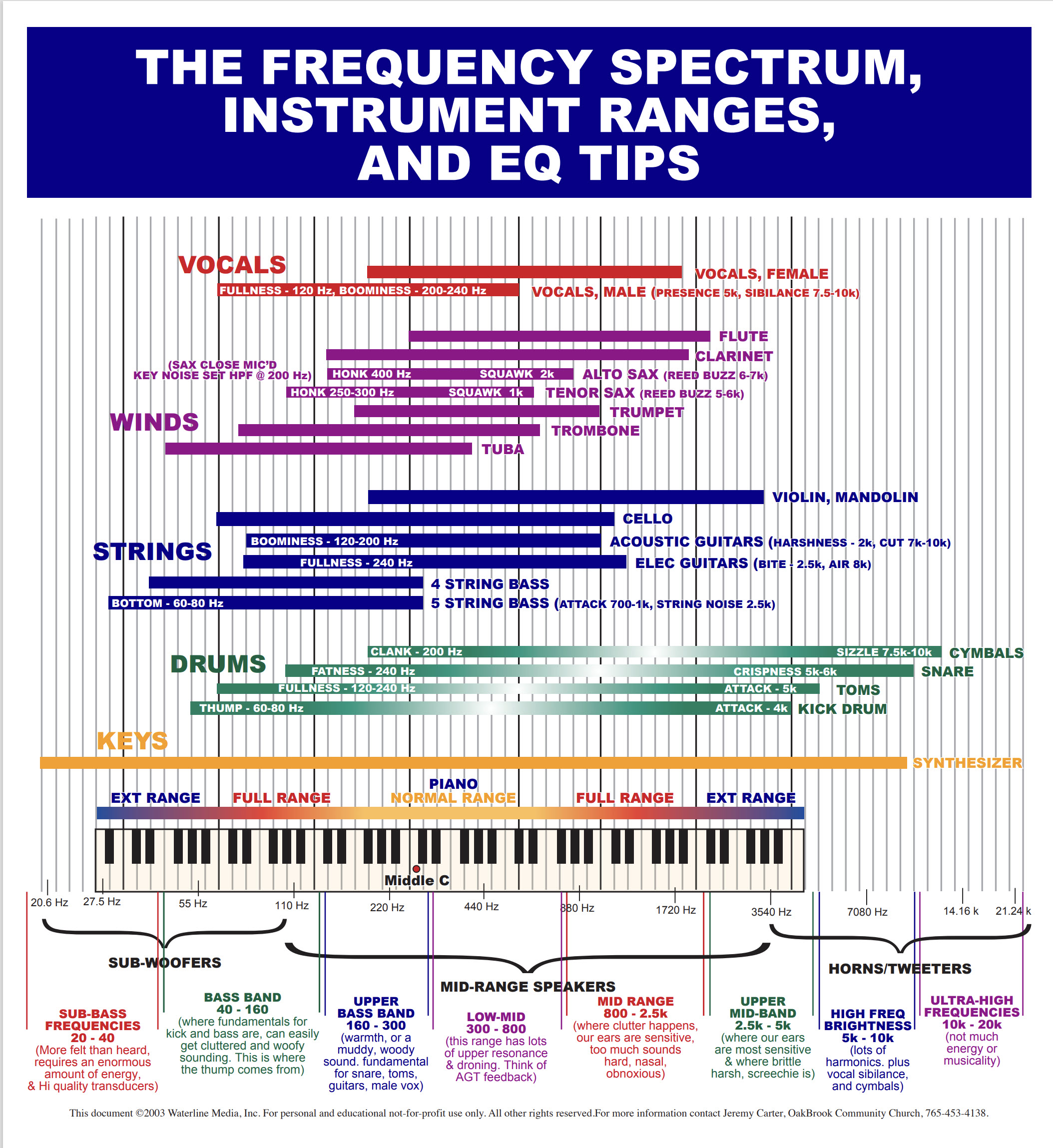
Up to about 1000 Hz, the L1s are almost omnidirectional. They become increasingly directional, with more sound in the 180-degree range facing forward as the frequencies rise beyond 1000 Hz.
Most of what we hear in the human vocal range and instruments is below 2000 Hz. See the colored chart below for more details.
If you find the L1s too loud when placed behind you, putting them beside or ahead of you will make very little difference for frequencies up to 1000 Hz.

Feedback
Feedback (high-pitched feedback) is typically at frequencies above 2000 Hz, so there may be some benefit to position the L1s outside the polar pattern of microphones if you have exhausted other approaches for dealing with feedback. You can do this by putting the L1s in line with or ahead of the microphones. T
Test Results
The average difference measuring in front of an L1 and directly behind it (180 degrees off-axis) is +3 dB SPL dBA and dBC. The noticeable difference is that the sound behind the L1 is muffled (mid-high frequencies less apparent).
Conditions:
- L1 Pro16
- In a free field (outside, no walls)
- Using white noise
- Testing with a Sound Pressure Level (SPL) meter
- A-weighted and C-weighted (dBA and dBC)
- Notes
- This 3 dB difference was measurable in a free field (no walls). When there are walls, the difference is less apparent due to room reflections.
- A change of 3 dB is accepted as the smallest difference in level that is easily heard by most listeners listening to speech or music. It is a slight increase or decrease in volume[2].
Further reading
To understand the difference between dBA and dBC, we need to look at the frequency curves they use